

Education in laboratory animal science
Education in laboratory animal science is compulsory for those who work and conduct research with laboratory animals at Karolinska Institutet.
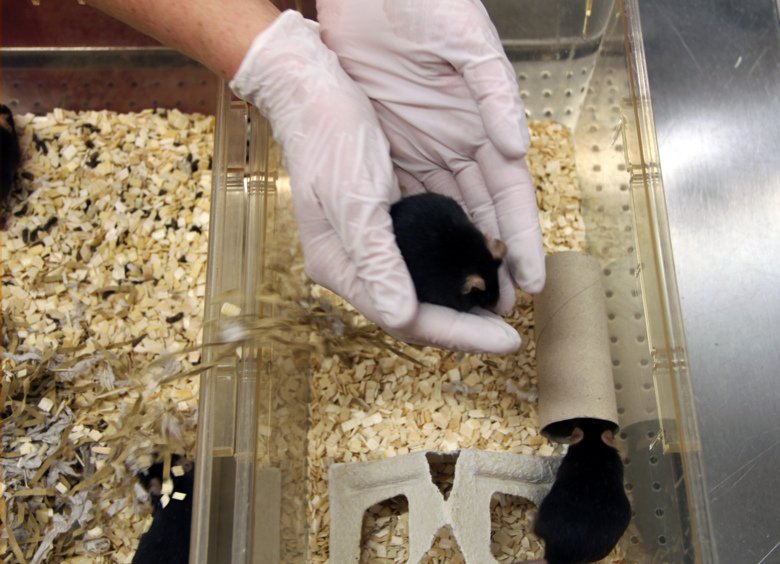
Comparative Medicine offers courses in laboratory animal science to students, doctoral students, researchers, and animal technicians at Karolinska Institutet and from other scientific institutions.
Our vision is to provide the best possible training in laboratory animal science. We are continuously looking to develop our existing course portfolio in addition to creating new courses in the area of laboratory animal science.
Educational requirements
Everyone must be adequately educated, trained and competent before working with animals at Karolinska Institutet. The requisite competence must be obtained, maintained and demonstrated (upon request). Educational requirements for animal experimentation.

Continuing professional development (CPD)
Several times a year we offer hands-on skills training sessions as well as numerous webinars which are listed here and in the KI calendar.
Mandatory CPD event on the new regulation, L151
The Swedish Board of Agriculture has published new regulations and, general advice for working with laboratory animals, the L151 which replaced the L150 on December 4, 2025.
Therefore, there will be mandatory CPD event for everyone working with laboratory animals and/or holding an ethical approval.
Register for a webinar below. Participating once is sufficient but mandatory. A zoom-link to the webinar will be sent to the e-mail address entered in the registration form.
Certificates will be issued to those following a complete webinar. Please make sure we can match your registered name with your zoom name while online during the webinar.
March 17 at 13:00-14:00
Register for this webinar here
Registration will close at 8:00
March 26 at 10:00 - 11:00
Register for this webinar here
Registration will close at 9:30
April 29 at 09:00-10:00
Register for this webinar here
Registration will close at 08:30
Webinar: Considering research animals all around the globe
Thursday April 2, 2026 at 14:30 - 15:30
Register for this webinar here
Please note! Registration will close 24 hours before the webinar on April 1 at 14:30).
Speaker: Cynthia Pekow, DVM, DACLAM, CPIA, Chief of the Veterinary Medical Unit (Veterans Affairs Puget Sound Health Care System), Seattle, Washington, USA.
Abstract
Many of us hold strong personal views about how we should relate to animals, and what considerations we owe them. These views are informed in great part by our culture as well as personal experience. How research with animal subjects is considered and regulated around the globe reflects cultural differences and commonalities. Might we arrive at a global consensus to harmonize work with research animals?
Speaker
Cynthia Pekow is a veterinarian with specialty certification in laboratory animal medicine. She works in Seattle, Washington, in the USA. Her career has primarily been in academia and government research, with many years of volunteer work and leadership positions in national and international organizations for laboratory animal science.
Webinar: Reduction and refinement of genetically altered mouse breeding - Controlling quality and quantity according to experimental needs
Monday, April 27, 2026 at 13:00-14:00
Register for this webinar here
Please note! Registration will close on Friday April 24, at 13:00).
Speaker: Dr. Karim Meshba, Institute of Human Genetics, CNRS, University of Montpellier, France
Abstract
Mice are the most widely used animal model in research, yet in Europe, 60% of genetically modified mice produced are never used in experiments. This lecture explores how optimizing transgenic colony management can significantly reduce this waste.
It introduces the DOPPUME framework (Define, Obtain, Protect, Produce, Use, Manage, Exchange) — a structured approach to the rigorous management of genetically modified lines. Key topics include precise model definition aligned with scientific objectives, control of genetic background to prevent drift, and accurate estimation of production needs based on experimental design and breeding schemes. Grounded in the 3Rs principles, DOPPUME provides practical tools for a more responsible and rational use of mouse models in research.
Speaker
Dr. Karim Meshba holds a PhD in Molecular and Developmental Cell Biology and brings over 25 years of experience in generating and analyzing genetically modified mouse models, gained at the Institut Pasteur and the CNRS. He has led both a breeding and assisted reproduction department (Janvier Labs) and a functional exploration facility at the CNRS, managing more than 500 mouse lines. As an expert at the French Ministry of Higher Education and Research, he contributed to the regulation of genetically altered animals. He currently works as a research engineer at the Institute of Human Genetics (CNRS, Montpellier), focusing on genetically modified mouse models to study telomeropathies.
Courses provided throughout the year - "Function A" and "Swedish law and ethics"
Function A (including Function C+D)
COURSE 3160: Function A - to carry out minor procedures on laboratory animals (3 cr.)
This is a compulsory course in laboratory animal science for all persons who will work on animals in research. It covers EU modules 1-7 where Swedish law and ethics is included (web-based theory) as well as EU modules 3.2, 6.2 and 8 (practical skills for minor procedures) on rodents, rabbits, pigs/minipigs, non-human primates, aquatic amphibians and zebrafish. For a competence assessment of your current level of education and training contact ntco@km.ki.se
Register here
Course fee
Free for doctoral students and postdocs registered at Karolinska Institutet (one species included). For the rest of KI participants is 5900 SEK (one species) (including INDI), and for externals is 7900 SEK (one species) (excluding VAT). Company employees please contact las-edu@km.ki.se
For more than one species please contact LAS-edu@km.ki.se
Swedish legislation and ethics
COURSE 3237: Swedish law and ethics on the protection of laboratory animals (0.5 cr.)
This is a compulsory course for all persons who will work on animals in research or is active in any way in projects involving research animals. For a competence assessment of your current level of education and training contact ntco@km.ki.se
If you take the entire Function A course the Swedish Legislation & Ethics course is included.
Course fee - Theory only
The course is free of charge for KI PhD-students and KI postdocs. Other KI participants pay a fee of 2000 SEK (including INDI). External participants pay a fee of 4000 SEK (excluding VAT). Company employees please contact las-edu@km.ki.se
Register here - Theory only
Course fee - Theory and assessment of practical skills
KI PhD-students and KI postdocs pay a fee of 2500 SEK/one species (including INDI), and other KI participants pay a fee of 4000 SEK/one species (including INDI). External participants pay a fee of 8000 SEK/one species (excluding VAT). Company employees please contact las-edu@km.ki.se
Register here - Including skills
Refinement of minor procedure skills
COURSE 5515/COURSE 5516: Refinement of minor procedures on mice/rats (0.5 cr.)
Register for your desired date and species at the course webpage.
This practical course is aimed at persons holding a Function A qualification who:
- have had some previous training in carrying out minor procedures on mice, but need an update or an upgrade in their skills (refinement) or in specific techniques; or
- will be resuming practical work on laboratory mice after a prolonged break; or
- are seeking added training in selected minor techniqu es such as e.g. intravenous injections or oral gavage
Course fee
The course is free of charge for KI PhD-students, KI postdocs and KM staff. Others affiliated to KI pay a fee of 3400 for Mice (5515) and 3900 SEK for Rats (5516) (including INDI). External participants pay a fee of 5400 SEK for Mice (5515) and 5900 SEK for Rats (5516) (excluding VAT).
Company employees please contact las-edu@km.ki.se
Courses spring 2026
March-April
Anaesthesia, analgesia and surgery in mice and rats
COURSE 2996: Anaesthesia, analgesia and surgery (in mice and rats)
The main goal of this course is to provide education and training in anaesthesia and analgesia in laboratory mice and rats.
Instructors
Emeritus Professor Paul A Flecknell, MA, VetMB, PhD, DECLAM, DLAS, DECVA, (Hon) DACLAM, FRSB, (Hon) FIAT, (Hon) FRCVS Newcastle University, and CEO of Flaire Learning Consultants, U.K.
Chiara Zullian, DVM, PhD, DES Laboratory Animal Medicine, Dipl. ECLAM Laboratory Animal Veterinarian Comparative Medicine, Karolinska Institutet.
Kajsa Witthuhn, DVM, Laboratory Animal Veterinarian, Comparative Medicine, Karolinska Institutet.
Dates
2026-03-10 Introduction to the course and on-site lecture
2026-03-11 – 2026-03-12 E-Learning and webinars
2026-03-17 OR 2026-03-18 Hands-on practical session
2026-03-19 Webinar and examination
Dates for the next course in autumn 2026 will be posted soon.
Course fee
Free of charge for doctoral students and postdocs registered at Karolinska Institutet. For other KI participants the cost is 8200 SEK (including INDI), and for external participants it is 9900 SEK (excluding VAT)
Function B - Design of scientific project and procedures using research animals
This is a compulsory course for all persons who will design procedures and projects involving research animals. For a competence assessment of your current level of education and training contact ntco@km.ki.se
Instructors
Experts in the field of laboratory animal science.
Dates
- 2026-03-23 – Introduction to the course
- 2026-03-24 – 2026-04-12 E-Learning
- 2026-04-13 – 2026-04-24 Lectures / Group work and examination
Dates for the next course in autumn 2026 will be posted soon.
Course fee
Free of charge for doctoral students and postdocs registered at Karolinska Institutet. For other KI participants the cost is 8900 SEK (including INDI), and for external participants it is 11500 SEK (excluding VAT)
Contact us
The Education & Training Unit at Comparative Medicine
E-mail: las-edu@km.ki.se