
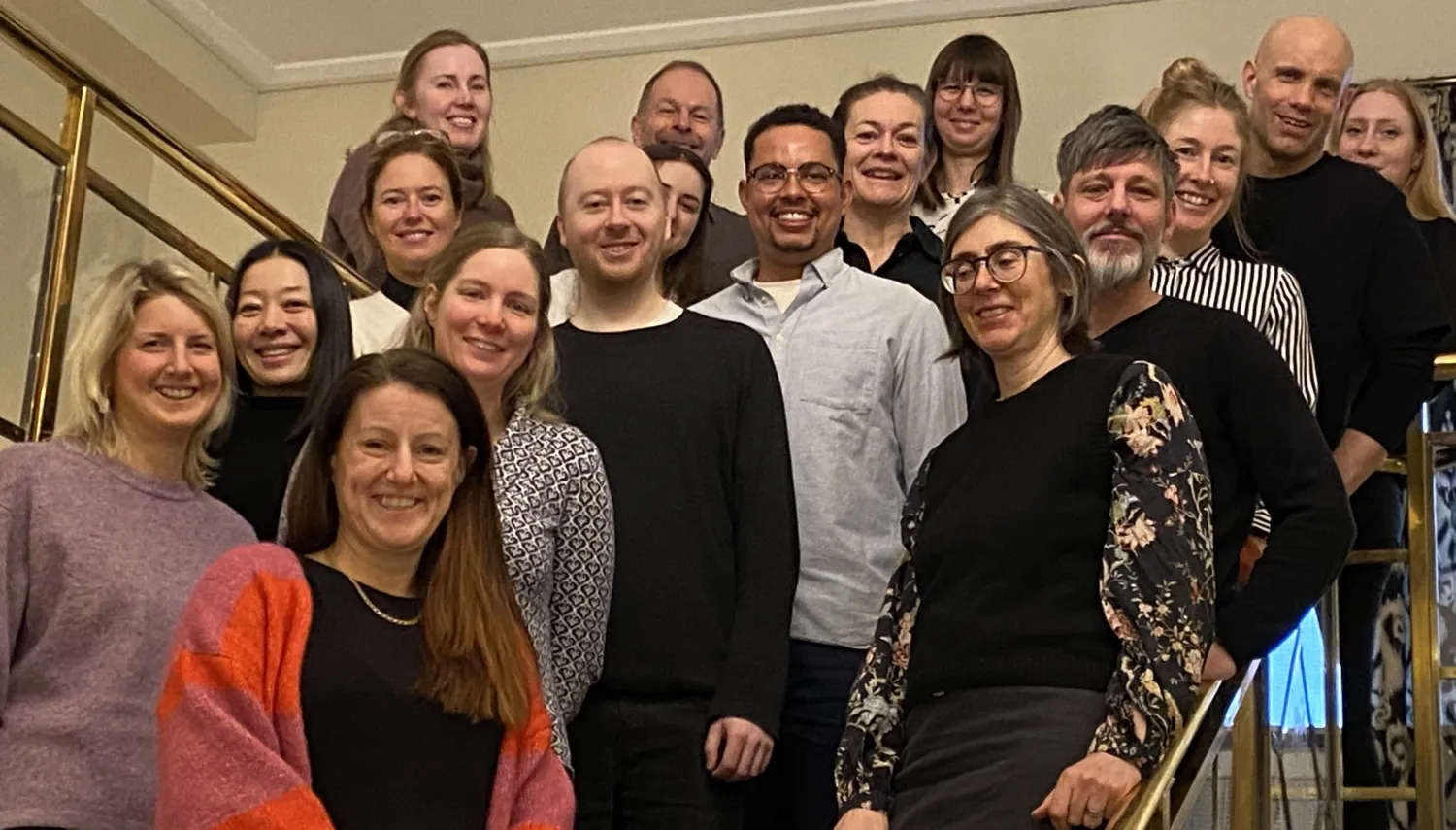
Balance, gait, exercise and physical activity in neurological diseases – Franzén Group

Translational research from exploring neuronal mechanisms to clinical interventions and implementation in Parkinson’s disease, Multiple sclerosis, stroke and spinal cord injury.

Forskningsfokus

Forskningsfokus ligger på translationell forskning från att utforska neuronala mekanismer till kliniska interventioner/implementering inom området neurologisk och geriatrisk rehabilitering. Våra specialintressen är balanskontroll, träning, fysisk aktivitet och fall hos äldre och individer med neurologiska sjukdomar som Parkinsons sjukdom, multipel skleros, stroke och ryggmärgsskada.

Mer information om vår forskargrupp finns på den engelska sidan.

Publications

Selected publications

All publications from group members

Funding

Grants

  • Motor-cognitive performance in people with multiple sclerosis - Brain activity and effects of balance exercise
    Norrbacka-Eugeniastiftelsen
    1 January 2024 - 31 December 2025
    Everyday living means being in complex environments and performing complex activities which usu¬ally consist of and require a combination of motor and cognitive skills. Having a neurological disease such as multiple sclerosis (MS) compromises motor-cognitive performance and corresponding brain activity. This leads to difficulties in balance and gait with or without the concurrent performance of cognitive tasks. New findings suggest that highly challenging, cognitively demanding physical exer¬cises could induce neuroplasticity. To further understand the underlying mechanisms we will study brain activity during complex walking in people with MS. The findings will give answers about the brain activity leading to motor-cognitive difficulties in MS and how it can be best targeted in rehabili¬tation. We will then perform a randomized controlled trial (RCT) in people with MS, determining the effects of a highly challenging balance training program on physical and cognitive functioning. This research project will, by use of a multi-disciplinary and multi-methodological approach, translate basic knowledge in neuroscience to applied research and clinical interventions. The overall purpose is to improve balance, gait, and motor-cognitive performance in people with MS and so reduce their fall risk, increase physical activity level, participation in everyday activities, rise self-management and health-related quality of life (HRQL). Improved functioning will reduce the burden on the indi¬vidual with MS and on the healthcare system/society. The goal of the research project is to explore motor-cognitive performance in people with MS as well as to investigate the behavioural effects in this group of highly challenging balance training in a full-scale RCT. In the project’s phase 1, a pio¬neering experimental set-up with a novel neuroimaging technique i.e., functional near-infrared spec¬troscopy (fNIRS) together with advanced gait analysis (APDM) will be used to assess complex walking in people with MS, in comparison with the outcomes of healthy controls. Then, in the project’s Phase 2 (not included in this proposal), an RCT of a progressive, highly challenging, balance training in¬tervention in people with MS will be performed. The specific aims of this application are to: 1. Investigate the effects of MS on motor-cognitive performance using measures of real-time brain activity (fNIRS) and advanced gait analysis of complex walking in comparison with healthy people 2. Link motor-cognitive performance to its underlying brain function obtained by fNIRS
  • Linking behavioural effects of intensive motor-cognitive exercise to biomarkers in people with neurological diseases
    Strategic Research Area Health Care Science (SFO-V)
    1 September 2023 - 31 August 2025
  • Swedish Research Council for Health Working Life and Welfare
    1 July 2023 - 30 June 2026
    Older people with Parkinson’s disease (PD) are one of the frailest groups in society, as debilitating symptoms place them at high risk for physical inactivity, social withdrawal and reduced quality of life. PD symptoms also lead to emotional and communicative changes which can severely affect social functioning and result in loneliness and stigmatization.  The proposal outlines five studies which ultimately aim to increase the accessibility and success of implementing evidence-based welfare technology to support active and dignified ageing with PD, and also older adults requiring support for chronic disease.   Research goals are:To investigate the efficacy of eHealth delivered motor-cognitive home training with regards to functional capacity, motor-cognitive ability, and physical activity behaviour, by performing a randomised controlled trial.To investigate how the use of novel wearable technologies can enhance the assessment of motor-cognitive performance in PD. To investigate patterns of participation in places for activities outside of the home among people with PD, and to explore how use of eHealth and other factors are associated with these patterns.To explore and describe perceptions of carers to people with PD regarding the potential for eHealth technology to support everyday life and participation.To investigate health care professional’s perspectives on determinant factors for the implementation of welfare technology for the care older adults with chronic diseaseOur methods will span a variety of designs and methods - a randomised control trial (RCT), cross-sectional observational studies and qualitative data collection. We will also investigate perceptions of welfare technology from multiple perspectives, including carers to people with PD and a wide range of health care personnel.  Findings from these studies will have direct relevance for older people living with chronic and progressive disease, their relatives or carers and for the future implementers of welfare technology- health care providers specialised in the care of older adults. The project group is multi-professional and incorporates physiotherapists, a Neurologist MD, occupational therapists and neuropsychologists. The planned studied are in conjuntion with clinical Geriatric hospital, which ensures timely implementation of findings. Studies 1 (RCT) and 2 (cross-ectional) are underway (commenced Oct 2022), all remaining studies studies are planned to be completed by summer 2026.
  • Brain activation during complex walking and cognitive dual-tasking in people with multiple sclerosis
    NEURO Sweden
    15 January 2023 - 31 December 2023
  • Swedish Research Council
    1 January 2023 - 31 December 2026
    Life means combining motor-cognitive skills, e.g., walking, talking and navigating. Aging or neurological diseases, e.g., Parkinson’s disease (PD) compromises these skills needed for an independent life. It is uncertain which brain alterations lead to these difficulties and how to target these heterogenous motor-cognitive difficulties. Current treatments apply a "one-size-fits-all" approach, which needs to evolve towards personalized rehabilitation, reaching beyond a simple adaption to disease severity.Our multimodal project combines physiotherapy, neurology, psychology and neuroimaging to characterize motor-cognitive skills during complex walking, identify underlying brain alterations and subtype PD to inform a novel exercise approach for people with PD. This 5 years proposal has 4 stages: 1) Exploring brain alterations and links to the motor-cognitive skills in healthy and PD 2) PD subtyping using neuroimaging, motor, cognitive and clinical data 3) Characterization of exercise responsiveness in PD and 4) Development and testing of a personalized motor-cognitive exercise program. We combine novel techniques for data collection with in-depth analysis of existing data (EXPANd trial). The results will have an immediate application and clinical relevance for personalized rehabilitation in older and PD. There is no cure for PD yet, thus positive findings would revolutionize treatment, giving new hope to patients for a life with improved health, independence and higher quality.
  • Limitations in balance and walking in people with multiple sclerosis – an intervention study based on mechanistic research and co-design
    The Promobilia Foundation
    1 June 2022 - 1 June 2023
  • A study of highly challenging balance training including motor/cognitive dual-task in people with MS
    NEURO Sweden
    1 September 2021 - 31 August 2022
  • Balance and gait during complex activities in people with multiple sclerosis and the experiences of limited balance
    Promobilia Foundation
    1 January 2020 - 31 December 2021
  • Balance and gait during complex activities in people with multiple sclerosis and the experiences of limited balance
    NEURO Sweden
    1 May 2019 - 31 December 2022

Staff and contact

Group leader

All members of the group

Other people connected to the group

  • Agoriwo, Mary