

Team Metabolic-epigenetic interplay in glial cells - Karl Carlström
The major goal of the lab is to understand metabolic and epigenetic interplay in glial cells during homeostasis and diseases.
Team leader
Karl Carlström
Assistant ProfessorMain projects
Subcellular compartmentalization
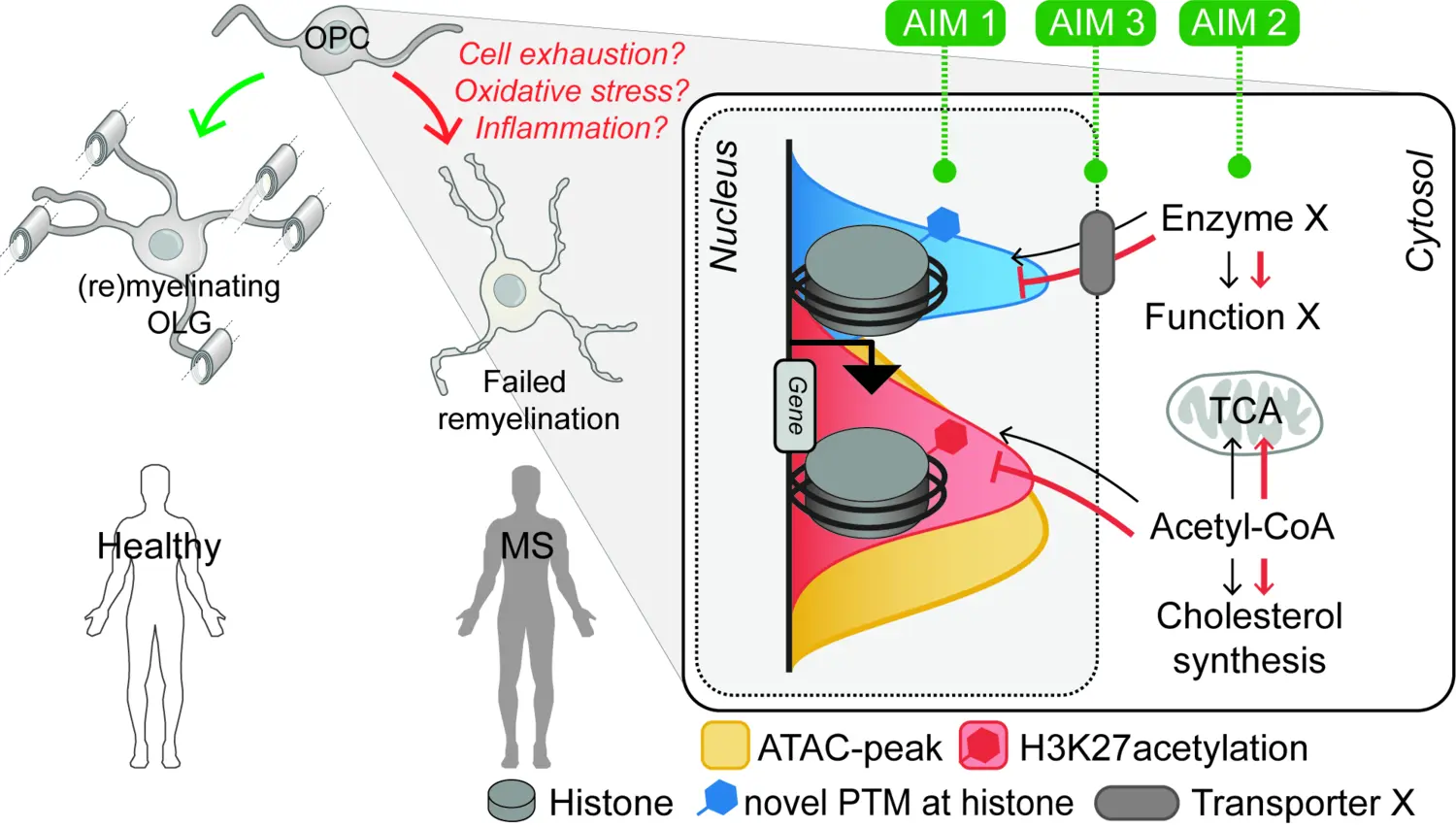
We have recently discovered novel proteins to translocate between subcellular compartments (including the cell nucleus) in an isoform and post-translational manner in glial cell. Using epigenetic profiling and reprogramming tools we able to explore previously unknown function following this re-compartmentalization in various model systems. Within this project we are also developing novel tools to decipher protein compartmentalization on a global high-throughput scale. A central goal is to integrate metabolic, epigenetic, and spatial proteomic data to uncover multi‑layered regulatory mechanisms that define glial cell identity and function.
Non-canonical histone modifications in glial cells
Multiple metabolites, also of high relevance to CNS-resident cells, have also been shown to serve as non-canonical histone modifier in addition to their canonical functions. This include e.g. lactate, serotonin and dopamine. We are studying how these metabolites are directly connected to epigenetic remodeling and transcriptional regulation. We aim to define how these regulatory layers shape glial cell behavior during development, homeostasis, and disease, with a particular focus on oligodendrocyte maturation and myelin integrity.
Metabolic pathways, essential in glial cells
By applying Cas9/CRISPR-based screens we are investigating essential metabolic pathways in glial cells and particular oligodendrocytes using iPSC. Our long‑term goal is to identify intervention points within metabolic–epigenetic networks that can be leveraged for therapeutic modulation of glial dysfunction.
Integrated glial systems biology
By combining spatial proteomics, metabolomics, and single‑cell epigenomics, we aim to build a systems‑level understanding of the regulatory circuits that govern glial identity, plasticity, and response to stress or disease. This integrative strategy enables us to uncover emergent properties that cannot be captured by single‑modality approaches.
Techniques and methods
Our lab applies multiple leading-edge technologies to address glial function. Including:
- CRISPR-based technologies (incl Cas9-Prime editing and CRISPRi/a screens)
- Optogenetics, scRNA/ATAC-seq
- NanoCut&Tag
- MPRA
- iPSC
- Experimental animal models
Publications
BIORXIV. 2025
Oligodendroglia as functional effectors of Multiple Sclerosis risk variants
Carlström K; Agirre E; Sun T; Dumral Ö; Kabbe M; Mahmud N; Kit Lor Y; Pahlevan Kakhki M; Khademi M; Jagodic M; Goldman S; Castelo-Branco G
BIORXIV. 2024
Single-nuclei histone modification profiling of the adult human central nervous system unveils epigenetic memory of developmental programs
Kabbe M; Agirre E; Carlström K; Baldivia Pohl F; Ruffin N; van Bruggen D; Meijer M; Seeker L; Bestard-Cuche N; Lederer A; Zhang J; Ahola V; Goldman S; Bartosovic M; Jagodic M; Williams A; Castelo-Branco G
Axonal mitochondria adjust in size depending on g-ratio of surrounding myelin during homeostasis and advanced remyelination.
Ineichen BV, Zhu K, Carlström KE
J Neurosci Res 2021 Mar;99(3):793-805
Gsta4 controls apoptosis of differentiating adult oligodendrocytes during homeostasis and remyelination via the mitochondria-associated Fas-Casp8-Bid-axis.
Carlström KE, Zhu K, Ewing E, Krabbendam IE, Harris RA, Falcão AM, Jagodic M, Castelo-Branco G, Piehl F
Nat Commun 2020 Aug;11(1):4071
Therapeutic efficacy of dimethyl fumarate in relapsing-remitting multiple sclerosis associates with ROS pathway in monocytes.
Carlström KE, Ewing E, Granqvist M, Gyllenberg A, Aeinehband S, Enoksson SL, Checa A, Badam TVS, Huang J, Gomez-Cabrero D, Gustafsson M, Al Nimer F, Wheelock CE, Kockum I, Olsson T, Jagodic M, Piehl F
Nat Commun 2019 Jul;10(1):3081
Alzheimer's risk variant APOE4 linked to myelin-assembly malfunction.
Carlström K, Castelo-Branco G
Nature 2022 Nov;611(7937):670-671
Grants
- Starting Grant: Swedish Research Council
- Postdoctoral Grant: Svenska Sällskapet för Medicinsk Forskning (SSMF)
- Exchange program: Nicholson Exchange Scholar
Open positions
We are looking for talented post docs with an ambition to explore new and unique aspects of glial cell biology using leading edge technologies.
If interested, please contact the team leader: karl.carlstrom@ki.se